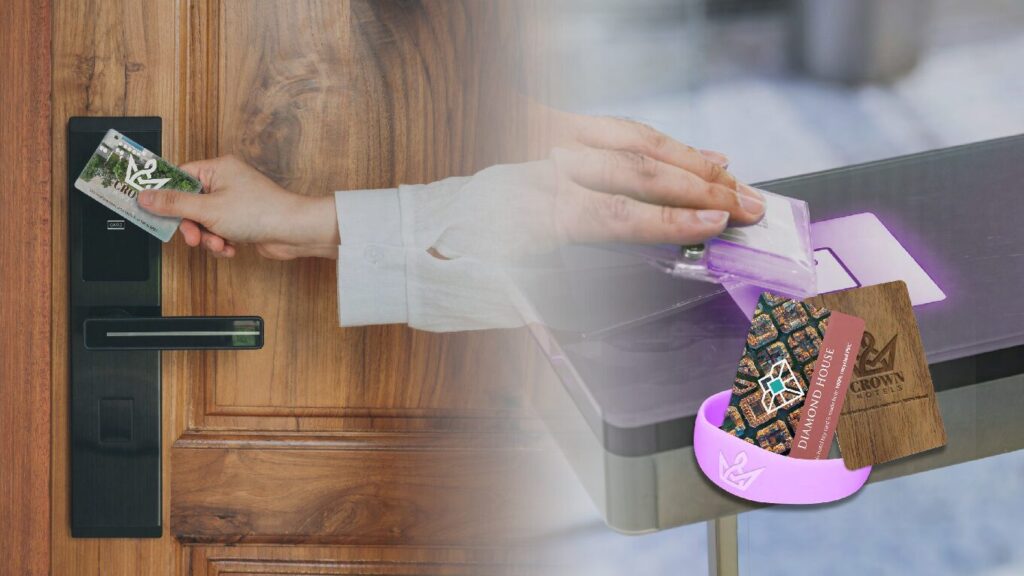
RFID Wristbands vs RFID Access Cards: Which is right for your Access Control?
News | October 15, 2026
Choosing the right credential for your access control
Access control systems are essential technology that provides automatic security to a site ensuring only authorised personnel can gain entry to a variety of locations including offices, construction sites, hospitals and even university campuses.
Using RFID, credential holders can carry a variety of form factors to grant access to their site. In this guide we compare RFID wristbands and RFID access cards to help you choose the right credential for your site, sector and budget.
How RFID credentials work
If you’re here you probably already know what goes into an RFID card however for those who might be new lets recap quickly.
An RFID credential contains a small chip and an antenna. When it comes within range of a reader, the reader powers the chip and reads its unique ID or stored data. The system then checks that ID against its permissions and unlocks the door, turnstile or locker.
The good news is that the chip inside a card and a wristband can be identical. Most access control systems run on one of two frequencies:
125kHz (low frequency): proximity technology such as EM4100 and HID Prox. It is simple, reliable and common in older systems, but offers limited security because the ID can be copied relatively easily.
13.56MHz (high frequency): smart technology such as MIFARE Classic®, MIFARE DESFire® and NTAG®. It supports encryption, stored data and cashless payments, and is the better choice for new installations.
Dual-frequency credentials combine both chips, which is useful if you are migrating from an older 125kHz system to a newer 13.56MHz one.
Because the technology is shared, the choice between a card and a wristband rarely comes down to your readers. It comes down to your users and your environment.
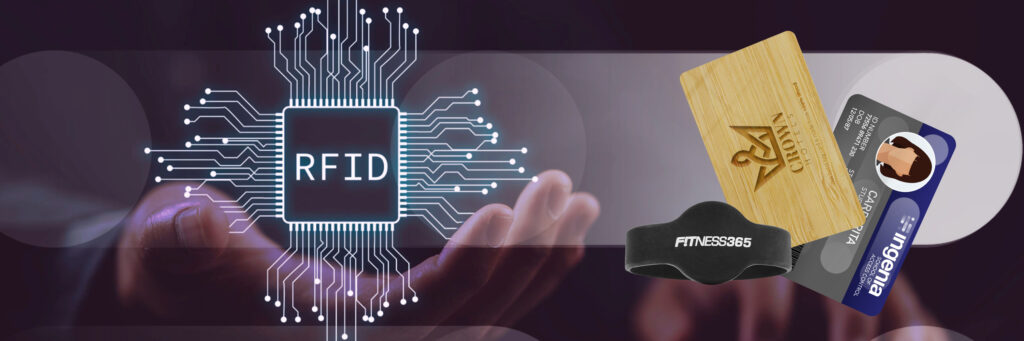
When to choose RFID wristbands
The most common time that an RFID wristband is better suited for a user than an RFID card is when users are active, busy or temporary. A wristband is worn and therefore is easier to carry, use and keep safe when compared with a card.
This means that places like gyms, leisure centres and swimming pools can all take advantage of the benefits of an RFID wristband. Spas and Hotels similarly face the same challenges as do waterparks, festivals and similar events.
As a form factor an RFID wristband is water resistant, hard wearing and most importantly flexible, this allows rapid deployment for events and appointments as well as peace of mind that the technology inside is not at risk of damage.
When to choose RFID access cards
In contrast to that the traditional RFID access card is a better suited solution when combined with more obvious uses of the form factor. By this we mean visible identification, now this doesn’t have to end at Photo ID, it extends to branding as well. Credentials like hotel key cards and membership/loyalty cards can be designed to act as free marketing for a business.
The use cases for access cards also include the standard office ID and visitor passes as well as a student ID badge for universities and colleges however the biggest benefit remains in cost. As a high volume solution RFID cards can be produced quickly and relatively cheaply when compared to RFID wristbands and therefore they remain the standard credential for most institutions/organisations.
Why not both?
Its worth mentioning that some sites will benefit from a hybrid approach to their RFID access control. You can even consider dual chip credentials if you have multiple readers across your estate.
FAQ
Will RFID wristbands work with my existing card readers?
In most cases, yes. If the wristband uses the same chip and frequency as your current cards, your readers will recognise it. Ingenia can match the chip very easily if you send us a sample of your existing credentials.
Are RFID wristbands waterproof?
Silicone RFID wristbands are fully waterproof and resistant to chlorine and salt water, making them ideal for pools, spas and waterparks. Fabric and paper-style wristbands are better suited to events and short-term use.
Which is more secure, a card or a wristband?
Security depends mainly on the chip, not the format. A 13.56MHz MIFARE DESFire® chip offers strong encryption in either a card or a wristband. Wristbands add practical security because they are harder to lose or share.
Are RFID wristbands more expensive than cards?
Wristbands usually cost more per unit than PVC cards. In wet or high-wear environments they often work out cheaper over time, because fewer need replacing.
Can RFID cards and wristbands be customised?
Yes. Cards can be printed in full colour on both sides, with photos, numbering and barcodes. Wristbands can be produced in custom colours with printed, embossed or debossed logos.
Find the right credential with Ingenia
Still unsure whether RFID cards or RFID wristbands are the right choice for you? Our team of RFID specialists can advise the best format for any project, it may even be a mix of both!
Get in touch using the details below to request product samples, start a quote and get tailored advice for your order:
Get in touch today by emailing us at info@ingenia-id.com or call us now on +44 (0)117 978 4777 to speak to a member of our friendly team.
You may also be interested in our Case Studies

In today’s competitive retail environment retaining customers is essential to remaining successful.

During the onset of the COVID-19 pandemic, and the resulting vaccinations that became available, it was suddenly necessary to supply healthcare volunteers with photo ID badges.

Wickes approached Ingenia regarding their loyalty scheme TradePro, which is a must for any professional looking to save money and get the most out of working with the retailer regularly.